

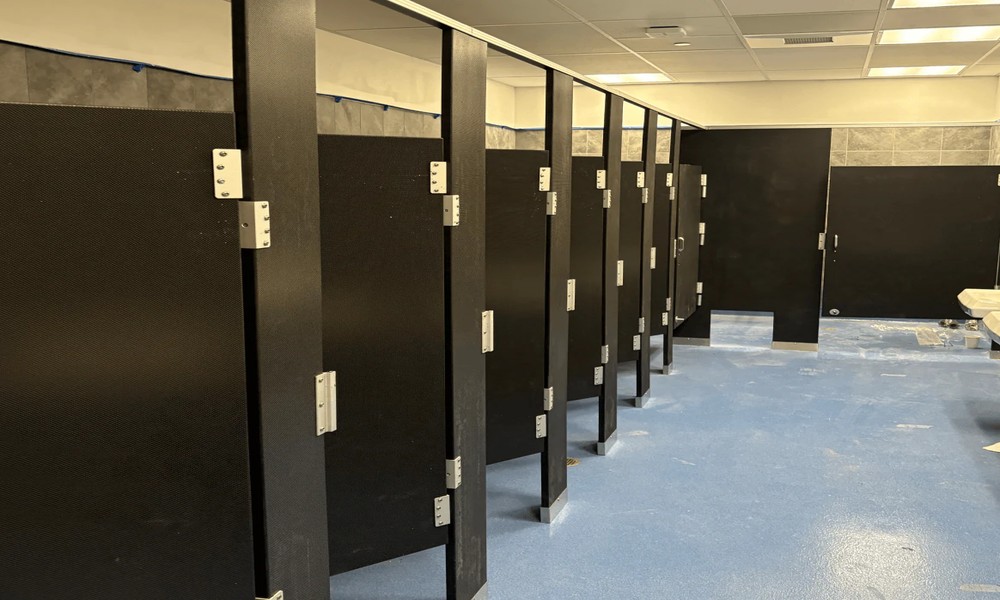
Partition pilasters and hardware systems are the structural elements that determine the long-term stability and appearance of a commercial restroom partition installation. The quality of these components, and the care applied to their installation, has greater influence on long-term system performance than panel material quality alone.
Pilaster foot adjustment systems that accommodate floor slope and tile variations without leaving visible gaps are among the most practically important design features in partition systems, because few commercial construction floors have the dimensional precision that inflexible pilaster bases require for a clean finished appearance.
What Pilaster Adjustment Systems Accommodate in Field Conditions
Field adjustment capability at pilaster bases allows installers to compensate for floor slope, tile grout joint alignment, and dimensional variation in structural floor conditions without requiring custom-fabricated filler components or visible gaps. Systems with 1-inch or more of vertical adjustment accommodate the floor variation encountered in most commercial construction projects.
Pilaster leveling is critical to door alignment throughout the service life of the partition system. Pilasters that are not plumb generate doors that rub, fail to latch, or swing open and closed without user input, creating the operational problems that generate most partition maintenance complaints.
How Door Hinge Selection Affects Service Life
Continuous-duty, self-closing hinges engineered for the specific weight and frequency of partition door operation provide substantially longer service life than general-purpose hinges applied to partition doors. Manufacturers of restroom partition systems with proprietary hinge systems specifically engineered for their door panel weights and anticipated duty cycles provide hardware that is matched to the structural requirements of the product rather than sourced as a generic component.
What Overhead Bracing Systems Provide in Structural Stability
Overhead continuous rails in braced partition systems distribute lateral loads across the entire partition assembly, reducing the cantilever demands on individual floor-mounted pilasters. In installations where floor-mounted pilasters would be structurally insufficient due to floor conditions or layout constraints, overhead bracing provides the alternative structural path required for a stable, compliant installation.
How Shimming and Leveling Procedures Affect Long-Term Performance
Improper shimming and leveling during installation creates latent structural problems that manifest as hardware loosening, panel cracking at stress concentrations, and progressive misalignment over the first years of service. Installation crews who follow manufacturer leveling and shimming procedures and verify plumb and level at each pilaster before finalizing anchoring produce installations that maintain appearance and function throughout their designed service life.
Partition pilaster and hardware system quality and installation precision have a larger practical impact on long-term partition performance than panel material selection in many commercial applications. The investment in quality hardware systems and careful installation procedure compliance is recovered through the reduced maintenance and hardware replacement events that properly installed, quality-hardware systems produce compared to commodity hardware installed under time pressure.
